
10x magnification is the industry standard for diamond grading. The 10x diamond grading loupe pictured here is the tool industry professionals use the most for diamond clarity grading.
One reason is because it is the most convenient, inexpensive, and portable way to magnify diamonds. Arguably, the other reason is because most consumers will not be able to use it with any degree of accuracy.
In that case, they're not likely to see the inclusions within the diamonds they are considering. Be that as it may, there are many jewelry stores that only provide their clients with 5-7x power loupes at the front counter.
Such tactics are intended to make it even more difficult for you to see the inclusions. In that event, you might mistakingly think that the diamond is higher clarity.

10X Diamond Grading Loupe.
When the truth is that you're simply using a lower degree of magnification to evaluate the inclusions. Obviously, the moral to the story is to check the degree of magnification to ensure you're something like this 10x diamond grading loupe from Amazon.
We use the GIA Gem Scope (pictured below) for grading purposes because it is a more precise instrument. In that case, we're able to examine diamonds using higher degrees of magnification. Such as 10x, 15x, 20x, 30x, 40x, 50x, 60x, and 70x magnification for which we will provide examples below.
10x Magnification Using a Microscope:

Leica GIA Gem Scope.
The GIA Gem Scope by Leica™ is the industry standard for diamond grading. As a matter of fact, it's probably the most popular microscope for diamond grading because of its affiliation with the GIA.
For our purposes, we kept one in the back for diamond grading and one out front on the sales counter for our customers. Obviously it's much easier for you to see inclusions using the magnification of a microscope.
Microscopes are easier to use for diamond grading for several reasons. Not the least of which is that the diamond is held in place with a pair of diamond tweezers. As a matter of fact, the tweezers are part of the stationary unit.
In that case, it is easier to focus on the inclusions without having to adjust for focal depth using a handheld loupe. At the same time, you don't have to worry about the diamond flying across the room if you squeeze the tweezers too tight.
This particular GIA Gem Scope has a range of magnification between 10x and 70x. Interestingly enough we attended a Health Fair a few years ago and the same set up was being used by a vitamin company to demonstrate how their product entered the blood stream. It was pretty cool to watch our blood cells moving around under 70x magnification on a glass slide.
10x Diamond Grading Loupe vs Microscope:
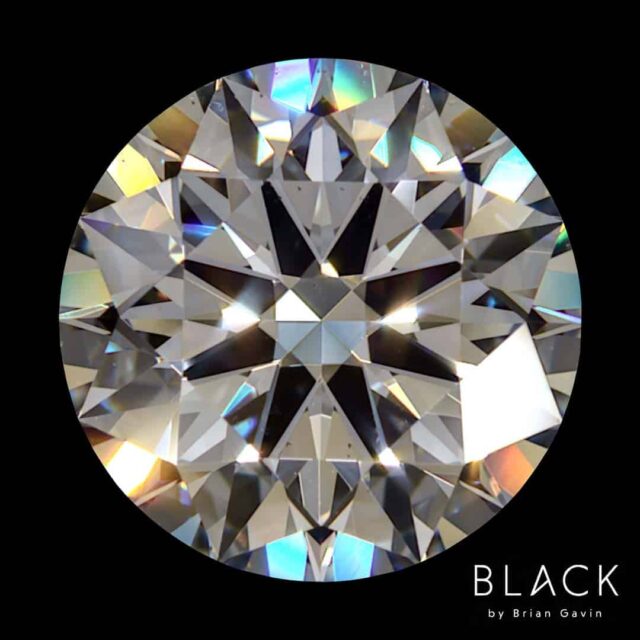
"Fire" of a Black by Brian Gavin Diamond.
In the first place, we need that the imaging system used by Brian Gavin is much higher quality than normal. As a matter of fact, it takes super high-resolution images that go way beyond lab-quality.
In addition, they publish the full size images, so that you can view them full screen on your computer. Under those circumstances, it will be much easier for you to see the inclusions within Brian Gavin Diamonds.
Obviously, that means that you have to account for differences in image quality and size. Otherwise, you might make the mistake of thinking that the inclusions are more apparent.
When the reality is that the image quality is simply much better than you're probably used to seeing. After all, the diamond on the left looks amazing, doesn't it?
17.9 mm US Dime @ 35x Power:
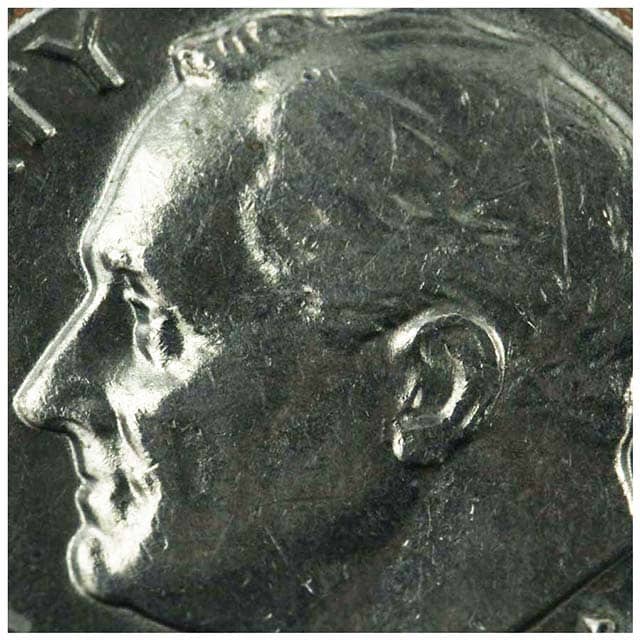
17.9 mm U.S. Dime at 35X Magnification.
Given that everything is always a matter of perspective, we photographed this dime using Brian Gavin's imaging system. A standard US Dime has an outside diameter of 17.9 mm.
Whereas a 1-carat round ideal cut diamond has an average outside diameter around 6.5 mm. As a matter of fact, that is about the same size as the eraser on a standard #2 pencil.
Obviously, the ultra-high definition resolution images that Brian Gavin provides make it much easier to see the inclusions. After all, just look at how easy it is to see all the little scratches that appear on the surface of this dime. At the same time, take note of how large the diameter of the dime seems to be in this photograph.
Degrees of Magnification for Diamond Clarity Grading:
As stated previously, the industry standard for diamond clarity grading is 10x magnification. Although that may be true, higher degrees of magnification make it easier to identify certain types of inclusions.
Here are some photographs of a standard 17.9mm US Dime as seen through our GIA Gem Scope. The images below show the dime as seen under 10x, 20x, 40x, and 60x magnification. Take a dime out of your pocket and hold it up to the screen in order to maintain perspective.

Example 10x magnification.

17.9mm US Dime @20x magnification.

17.9mm US Dime @40x magnification.

17.9mm US Dime @60x magnification.
10x Magnification Example:

#2 Pencil Eraser @10X Magnification.
In case you're wondering about how other things look at various degrees of magnification, let's examine the pencil on your desk. Go ahead and pick it up, then hold it up to the screen for the sake of comparison.
By the way, the pink eraser on a standard #2 yellow pencil measures 6.5 mm in diameter. As a matter of fact, that is about the same size as the average diameter of a 1-carat round ideal cut diamond. It's important to keep this kind of thing in mind when evaluating inclusions using the diamond clarity photographs provided.

Tip of a Pencil @10x Magnification.
The picture on the left shows the sharpened tip of a standard #2 pencil as seen under 10x magnification. That is the industry standard for diamond clarity grading. Needless to say that those inclusions that might seem so big on your monitor are extremely minute.
With that in mind, we recommend VS-2 clarity diamonds quite highly because they face-up eye-clean. Whereas we've always been able to find the inclusions in SI-1 clarity diamonds without magnification. Especially when we know where and what to look for in terms of the inclusions within the diamond.
Diamond Clarity Photographs:
Now, that you've had an opportunity to calibrate your perception, let's look at a diamond under varying degrees of magnification. For this purpose, we'll be be using some file photographs of a 0.811 carat, D-color, VS-2 clarity, ideal cut diamond.
In this case, the diamond measures 6.10 - 6.15 x 3.66 mm. That means that it has an average outside diameter of 6.125 mm which is smaller than the eraser pictured above. The primary inclusions are two small feathers that appear in the lower pavilion section.

VS-2 Feather 10x Magnification.

VS-2 Feather 20x Magnification.

VS-2 Feather 40x Magnification.

VS-2 Feather 60x Magnification.
The inclusions are not visible to us without magnification because this is a VS-2 clarity diamond. However, the feathers are readily and immediately visible using magnification. At least from this vantage point where we're highlighting the location for you. As a matter of fact, it took us a few minutes to find the inclusions to begin with.
Keeping Things In Perspective:
Let's take a moment to think about this for the purpose of maintaining perspective when grading diamond clarity. As stated previously, the diamond above has an average diameter smaller than a pencil eraser. And yet, the primary inclusions are readily and immediately visible using standard 10x magnification.

High Resolution Video vs Actual Size.
Or, at least it might seem that way when we've taken the time to point the inclusions out to you. Because we practically burned our eyes out trying to find those feathers with a 10x diamond grading loupe.
Suffice to say that it was much easier to find the inclusions using the controlled elements of our GIA Gem Scope. As a matter of fact, the same premise holds true for the high-resolution images that Brian Gavin provides.
We asked Brian Gavin to take the picture on the left in order to demonstrate the difference between perception and reality. The diamond held in the tweezers is this 0.828 carat, F-color, VS-1 clarity, Black by Brian Gavin diamond. As a matter of fact, it it has an average outside diameter of 6.11 millimeters.
But, it looks freaking HUGE in the ultra-high-resolution video! Especially if you click on the magnifying glass icon in the lower right corner that will make it full screen.
How Big Are The Inclusions?

California Black Ant @20x Magnification.
At some point in the conversation, you're likely to ask: "So, how big are the inclusions?" And that my friend, is how we ended up taking the picture of the ant that you see on the left.
Because our response with regards to the feathers in the VS-2 clarity eighty-pointer above was: "About the size of the hair on a gnat's ass." To which the client responded by asking: "How big is that?"
Obviously, we couldn't find a gnat, but here shows the hair on an ant's ass at 20x. And with that, we rest our case. Our Concierge Service is happy to answer any questions.